Keiu Talve
Expert in Social Services and Quality Management, Trainer, Auditor
Head of Quality and Services at Südamekodud
Founder of the Quality Centre Innostep
For many, quality is an abstract concept. It seems unattainable, or it is assumed that a service is of high quality if clients do not complain. In reality, the quality of social services comes down to very practical things: staff competence, the needs of service users, and management. Quality has clear and specific criteria that can be measured.
Conscious management and systematic work are the key conditions for developing any high-quality service. One of the founders of quality management, Edward Deming (1900–1993), said: “It is not enough to do your best; you must first know what to do, and then do your best.” Otherwise, we may spend a lot of time and energy on the wrong things. First and foremost, we must think about the results we want to achieve and then choose the right actions to reach them.
First, it is necessary to understand what the employees’ needs are — what result is desired to ensure their well-being — and only then can actions be taken.
The same principle applies to recruiting, retaining, developing, and supporting employees. It is necessary first to understand the employees’ needs — the outcomes that ensure their well-being — and only then begin to act.

Human resource management is a key part of any organization’s quality system. It is important to manage people systematically and consciously — those who work together toward a common goal. Without people, social services would not exist, as they are built through the interaction between the worker and the service user.
In Estonia, the principles of quality in social services are established by the Social Welfare Act (§3, subsection 2) and detailed in the Quality Guidelines (Social Insurance Board, 2018). Among them is the requirement that employees must be competent and follow ethical principles: “Services are provided by qualified workers whose professional development is continuously supported by the service provider. The provider also defines the ethical standards that employees must follow in their work.”
It is important to manage people systematically and consciously as they work together toward a shared goal.
The quality principles outline both employee duties (such as adherence to ethical standards) and rights (such as receiving employer support for professional development). The guidelines also provide direction on a safe and suitable work environment, clothing, equipment, and management practices. Other requirements mainly concern the provision of appropriate and necessary services to clients — but they can only be implemented by employees.
The European Quality in Social Services model (EQUASS), which builds on the principles of social service quality, goes even deeper in defining the principles of human resource management in care institutions, emphasizing the importance of supporting employees. Beyond competence and ethical practice, the system sets the standard of hiring skilled staff who align with the organization’s goals, deliver person-centred services, and foster an inclusive organizational culture. The organization ensures employee well-being, health protection, safety, and opportunities for development. As a general principle, organizational culture should also be based on diversity, which is a key aspect of sustainable service.
It is important for an employer to create an environment where employees feel safe, where their development is supported, and where mistakes are seen as opportunities for learning rather than reasons for punishment.
Institutions should apply all these principles in order to provide quality social services, following them systematically and consciously. First, it is important to define what the principles of quality mean for the organization or specific service. Then, processes and procedures must be described to ensure a systematic approach. Finally, the agreed principles must be put into practice.
Human resource management is strongly framed by the organization’s values, which help in setting goals and making important decisions. Values are the foundation on which the entire framework, including HR work, is built. They ensure that decisions and choices are made consistently rather than based on mood. Thus, values guide employees and provide a sense of security in their daily work.
The EFQM Excellence Model (2024) is an international quality framework for development-oriented organizations. It helps organizations move toward creating value for their stakeholders. In the context of HR, the EFQM Foundation defines organizational culture as “a set of internal values and norms that, over time, influence how employees interact with each other and with key stakeholders outside the organization.” To shape such a culture, it is essential to value innovative, creative, and improvement-oriented thinking, as well as “out-of-the-box” ideas that help achieve goals.
More and more attention is being paid to work-life balance, to which both employers and employees can contribute.
It is essential for employers to create an environment where employees feel safe, where their development is supported, and where mistakes are treated as learning opportunities rather than reasons for punishment. Valuing honest feedback is equally important.
The above guidelines and models are useful for any organization or service provider that seeks to systematically improve its service. Each framework’s principles are interconnected and cannot be implemented in isolation. EQUASS even notes that although the model defines ten principles, the eleventh is that all the principles are interconnected and interdependent. This means staff should be aware of all quality aspects and involved in their development. Employees should also be asked what they need so that managers know what to focus on in hiring, retention, training, and recognition.
 Is Employee Well-Being the Responsibility of the Employee or the Employer?
Both employers and employees have expectations of each other. The employer expects the employee to be enthusiastic, diligent, and to give their best every day. The employee, in turn, expects good pay, a pleasant physical working environment, and an emotionally supportive team. Moreover, today’s employees expect a variety of benefits — from health promotion support and free meals to a 13th salary. Creating a motivating value proposition that reflects employees’ needs is a challenge for organizations in the social sector.
Employers and employees together build a good reputation and quality so that people want to be part of the organization.
Creating a supportive work environment does not always require money but does require thoughtful and deliberate action. The key components of a supportive environment are attitudes and values. A stable workplace, a supportive team, meaningful leadership, and team training may seem self-evident, but in reality, business is influenced by risks and broader social processes.
Self-care includes everything an employee consciously does to maintain their mental, emotional, and physical health. This can include activities after work that help them relax and recharge for the next day: sports, spending time in nature, massage, listening to music, watching films, spending time with friends or family, and getting enough sleep. Everyone should find what helps them personally restore energy and rest. However, there are some universal factors that support self-care, such as healthy eating, regular exercise, and good sleep hygiene.
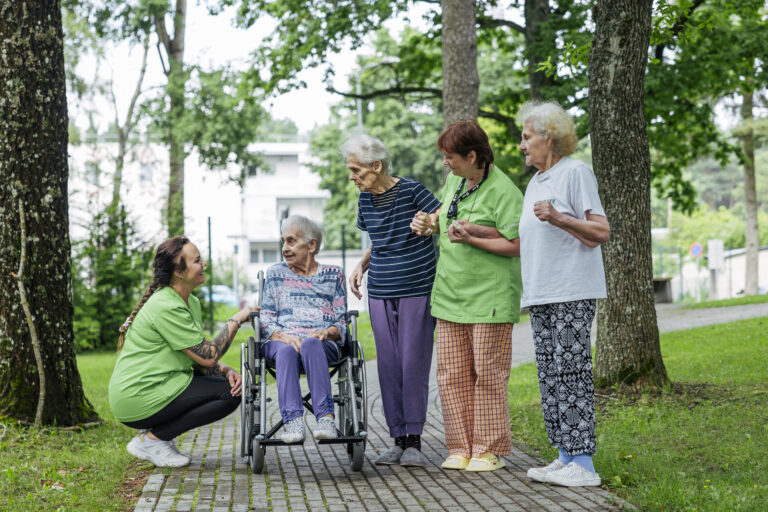
In the care sector, many jobs involve helping others. For such workers, their own well-being is especially important to prevent burnout or exhaustion. It is crucial in the workplace to support and notice one another — for example, if someone looks tired or is frequently ill. This helps maintain team well-being and, consequently, ensures service quality.
Supportive leaders are the foundation of good teamwork and a positive organizational climate, which determine employee well-being.
Increasingly, there is talk of achieving a healthy work-life balance — something that both the employer and the employee can contribute to. Avoiding overtime, planning time effectively, finding work that matches one’s interests and abilities, and identifying energy-restoring or draining activities are just a few examples. While the employer can do a lot for employees, each person is also responsible for engaging and taking care of themselves. There must be a balance between what an individual does for their own well-being and how the employer supports them at work. It is essential that the organization has carefully planned its support measures, based on employees’ needs, and made them available.
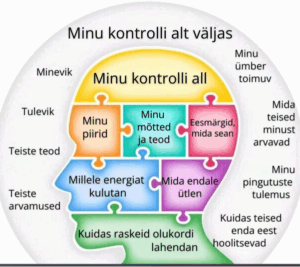
In self-care and in shaping a supportive work culture, one should focus on what can be influenced personally (one’s attitudes, mindset, and health) versus what cannot be changed (e.g., others’ actions and opinions, the past, or what others think of me). This is emphasized by both the leaders of the Estonian mental health portal Peaasi and world-renowned leadership and personal development experts. Instead of spending time at work or home complaining about what has been done wrong (which can sometimes be necessary just to let off steam), it is better to initiate discussions that help improve life, situations, services, and overall mood.
Self-care covers one’s physical condition, mood, and mental health. The workplace may offer good conditions, strong relationships, and a supportive team, but if a person is struggling with personal issues and is not ready to accept help, it’s hard for the employer to assist effectively. Problems can be discussed and the employer can be flexible with work arrangements, but the willingness to find solutions must come from the individual.
If processes are not well thought out in an organisation, you cannot expect all employees to interpret them the same way.
In addition to benefits, employees expect employers to offer developmental training. Staff should be competent, enthusiastic, motivated, embody the organisation’s mission, vision and values, and keep up to date. Providing professional training is essential, but equally important is the employee’s own desire to develop (e.g., reading professional literature).
As competition for talent intensifies, employers have become more flexible and now focus on supporting retraining. So-called soft skills — communication, openness, teamwork, and a willingness to learn and grow — have become crucial, enabling faster adaptation to new fields.
Training must go hand in hand with application. Completing an ergonomics course won’t protect health unless the knowledge is used in practice. The employer can provide tools; the employee is responsible for using them — for example, using a hoist when lifting an elderly person.

Across Estonia, Südamekodud primarily provides general care services for older people. We are a fast-growing young organisation: we started in 2017 with one care home in Käru and, in September 2024, opened our 12th home in Tartu near the Estonian National Museum.
In addition to building our quality system, we focus on our people and retention. We clearly communicate employer expectations to Südamekodud staff. Through regular employee satisfaction surveys, we collect feedback on task execution and learn employees’ expectations for their work and work environment. Our current strategy includes becoming an attractive employer. The care sector faces a labour shortage. As society ages, the sector expands and many jobs are added. Care also competes with healthcare and services for talent, making it increasingly difficult to hire care workers. Investing in employee satisfaction, comfort and well-being is essential to remain a competitive and reliable employer.
The core of a supportive work environment is shared attitudes and values.
The employer’s task is to ensure employees feel valued and want to stay, while also attracting new colleagues. Employers and staff together build a strong reputation and quality so that people want to be with us. Based on this goal, Südamekodud has set sub-goals and actions to achieve the desired outcomes.
We implement unified ways of working across all our care homes to ensure a shared understanding of daily routines. Common goals are central; we emphasise and monitor them in practice. We have created a recognition policy at Südamekodud that includes day-to-day and annual acknowledgements, celebrating career milestones, health-promotion measures, team events, and other benefits that make work engaging.
Defined recognition practices tell employees what work is valued and what they can expect from the employer. Shared hikes and events, financial perks, acknowledging good work, and leading by example all contribute to delivering higher-quality services to our clients. Happy, motivated staff pass their positivity on to the elderly people for whom we create a dignified living environment every day. At Südamekodud, a late-spring nature hike with the board, leadership and staff has become a tradition — trekking by day and spending time together in the evening to build team spirit.
To ensure service quality, rota-based scheduling is becoming increasingly important. The EU Working Time Directive has recently come into effect to guarantee sufficient rest. We consider it essential that carers working long shifts are rested before the next day begins. It is challenging for employers to ensure this because many people have multiple jobs. Although we try to provide adequate rest for everyone, we cannot control how individuals use their free time. In becoming an attractive employer, we strive to accommodate employees so they don’t overwork and can protect their mental health.
The heads of Südamekodud’s 12 care homes are the key decision-makers for hiring, retention and support. Supported leaders are the basis for strong teamwork and a positive climate, which underpin staff well-being. We provide managers with training and study visits to social-care institutions in other European countries. For example, we have observed care provision in Finland. We also used Erasmus+ to organise mobilities, giving managers the chance to learn about elderly care in Malta, Ireland and Spain. Each visit confirmed we are on the right track and offered inspiration and practical insights to improve our services. Travelling together also strengthens teamwork and internal collaboration.
This year we submitted a new Erasmus+ project application to offer similar international learning opportunities to our care managers and nurses.

Ene Katkosilt, Manager of Merivälja Südamekodu
Study visits are very useful and interesting for a manager of a social service institution. From recent Erasmus+ programme trips, I brought back knowledge and tips for offering more personalized care to residents. For example, during a visit to a private nursing home in Ireland, I got the idea to organize a joint ice cream party for our residents, staff, and their loved ones—especially the residents’ children and grandchildren—to bring them together for a pleasant time.
Last year, at the end of the school year in June, we held our first ice cream party, which was warmly received by all participants. We hope to make it one of Merivälja Südamekodu’s summer traditions.
More broadly, study visits have encouraged me to think about how, as a manager, I can help my team members do their jobs well. I also encourage employees to share what I, as a manager, can do for them to make our care home function better.
I also encourage other institution managers to take part in study visits—they offer a chance to step out of daily routines, gain inspiration, and reflect more deeply on one’s work.
 If processes in an organization are not well thought out, one cannot expect all employees to understand them in the same way. To implement work processes, it is important to involve employees in describing them, then clearly present them to everyone, constantly remind and relate them to specific situations, so that everyone develops a shared understanding and the habit of acting accordingly. Naturally, developing a shared understanding takes time, but without it, expected results will not follow. Dignity, privacy, the safeguarding of rights, empowerment, and ethics—these are the principles on which quality social services stand, and they should be clearly understood by everyone.
In social care, employees are the foundation of everything: without supported and self-caring workers, care for others cannot be ensured. A shared value system, culture, and agreed work practices are the foundation of quality service.

Südamekodud AS
Register code 14168513
Karjavälja st 4, Tallinn 12918
[email protected]