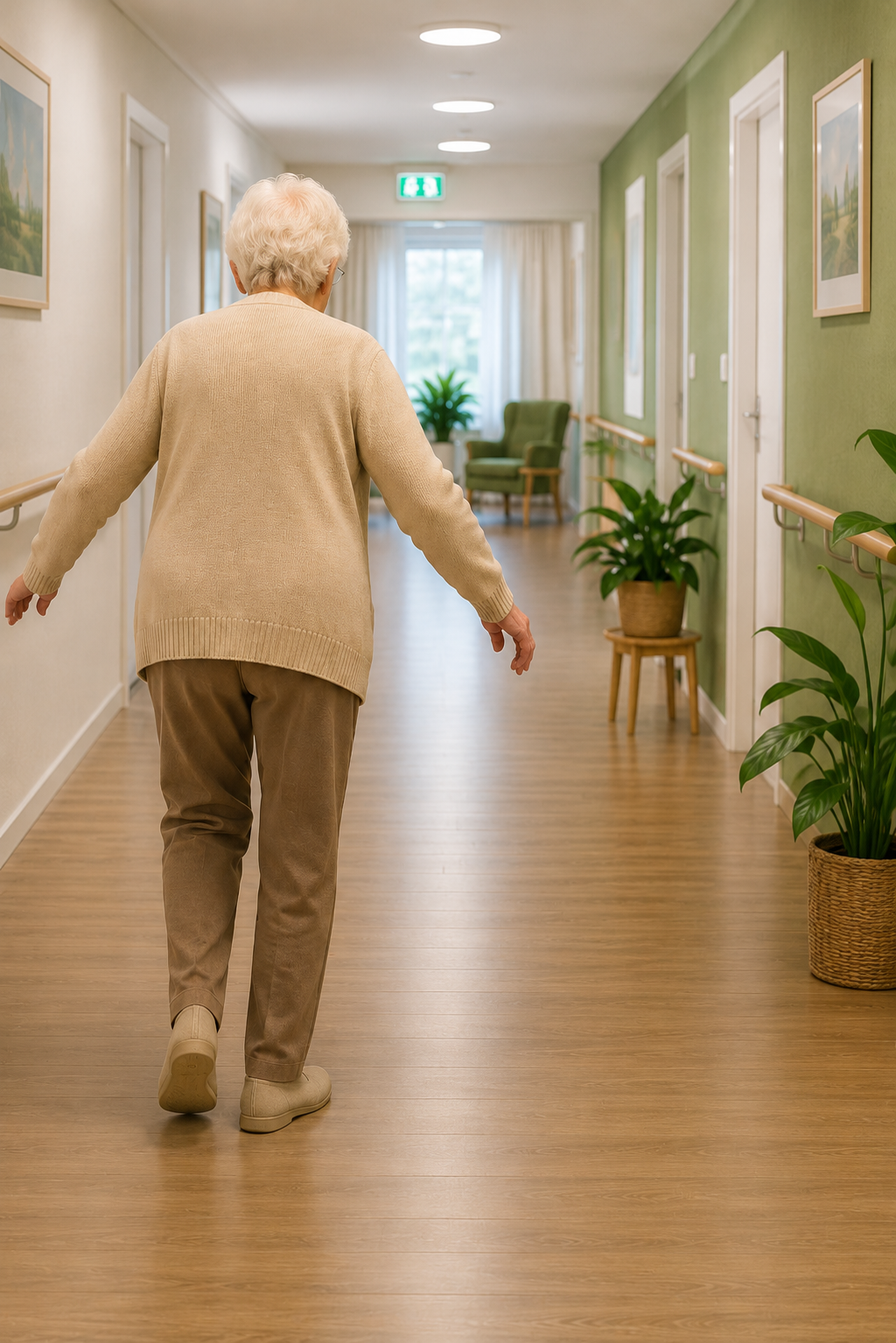
Dementia does not affect memory alone. It can also change how a person sees, hears and interprets what is happening around them. What appears to us as an ordinary floor, reflection or shadow may mean something entirely different to a person with dementia.
Our senses constantly provide the brain with information about the world around us. With dementia, however, the brain’s ability to interpret this information correctly may change. A person’s eyes may see an object clearly, but the brain may give what they see a different meaning.
Therefore, instead of asking “Why are they behaving like this?”, it may be better to ask: “What are they seeing or experiencing right now?”
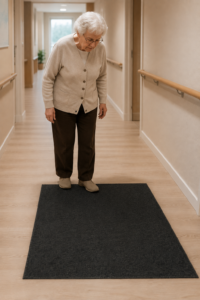 A dark rug may look like a hole
For example, a dark rug on a light-coloured floor may look like a hole, step or drop to a person with dementia. They may stop in front of it, try to walk around it or refuse to go any further.
Patterned floors, strong contrasts or shiny surfaces may cause similar confusion. It is therefore advisable to use calm, uniform flooring and good lighting wherever possible in an environment intended for a person with dementia.
There may be “someone else” in the mirror
A person with dementia may not always recognise their own reflection. They may think that there is a stranger in the room. After dark, a reflection in a window may also cause confusion or fear.
In such a situation, saying “But there is no one there” may not help. To the person, the experience is real.
It is better to try to understand whether the person feels frightened or insecure and to reassure them. Sometimes it helps to close the curtains, adjust the lighting or redirect their attention to a familiar activity.
Spatial awareness may change
Dementia may also affect a person’s ability to judge the distance and position of objects. They may reach for a cup but miss it, or find it difficult to judge the height of a step.
This does not necessarily mean that the person is being inattentive. The reason may lie in how the brain processes visual information.
The environment can make a significant difference. Good lighting, clear contrasts and minimal visual clutter make it easier and safer to move around.
Sometimes a person may see or hear something that others do not experience
In the case of altered perception, something is present in the environment, but the person interprets it differently—for example, they may mistake their reflection for another person.
When experiencing a hallucination, a person may see, hear or, less commonly, feel something that others do not experience. For example, they may see a person or animal that is not actually in the room.
The most important thing to remember is that the experience is real to the person.
There is no need to argue with them about whether what they see is “really there”. It is far more important to notice the emotion behind the experience and provide reassurance: “That must feel frightening. I am here with you.”
A calm voice, a familiar activity, music, looking at photographs or simply being together may help.
Let us try to see the world through their eyes
If a person with dementia refuses to enter a room, becomes frightened by what appears to be an empty space or avoids a particular floor surface, it is worth taking a closer look at their surroundings.
- Is the room too dim?
- Does the floor have a strong pattern?
- Is someone reflected in the window?
- Could a shadow look like an object?
- Are their glasses and hearing aid working properly?
Sometimes a situation that appears to be a major problem is caused by a relatively minor environmental factor.
However, if there is a sudden and significant change in perception or behaviour, it is advisable to consult a healthcare professional, as it may be caused by another health problem.
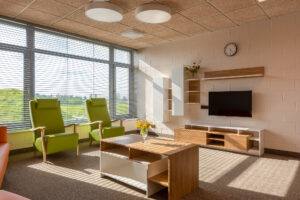 The environment can support the person
A dementia-friendly environment does not need to be complicated. Good lighting, calm colours, familiar objects and clear contrasts can make everyday life considerably easier.
The most important principle is even simpler: we do not always need to correct the person’s understanding of the world. Sometimes we can instead make the world around them a little simpler and safer.
This helps the person maintain their dignity, sense of security and as much independence as possible.
This article was prepared using materials from Dementia UK on perceptual changes associated with dementia and dementia-friendly environments.